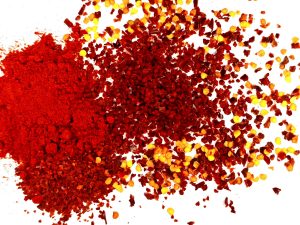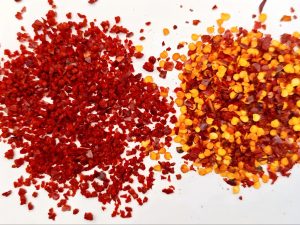
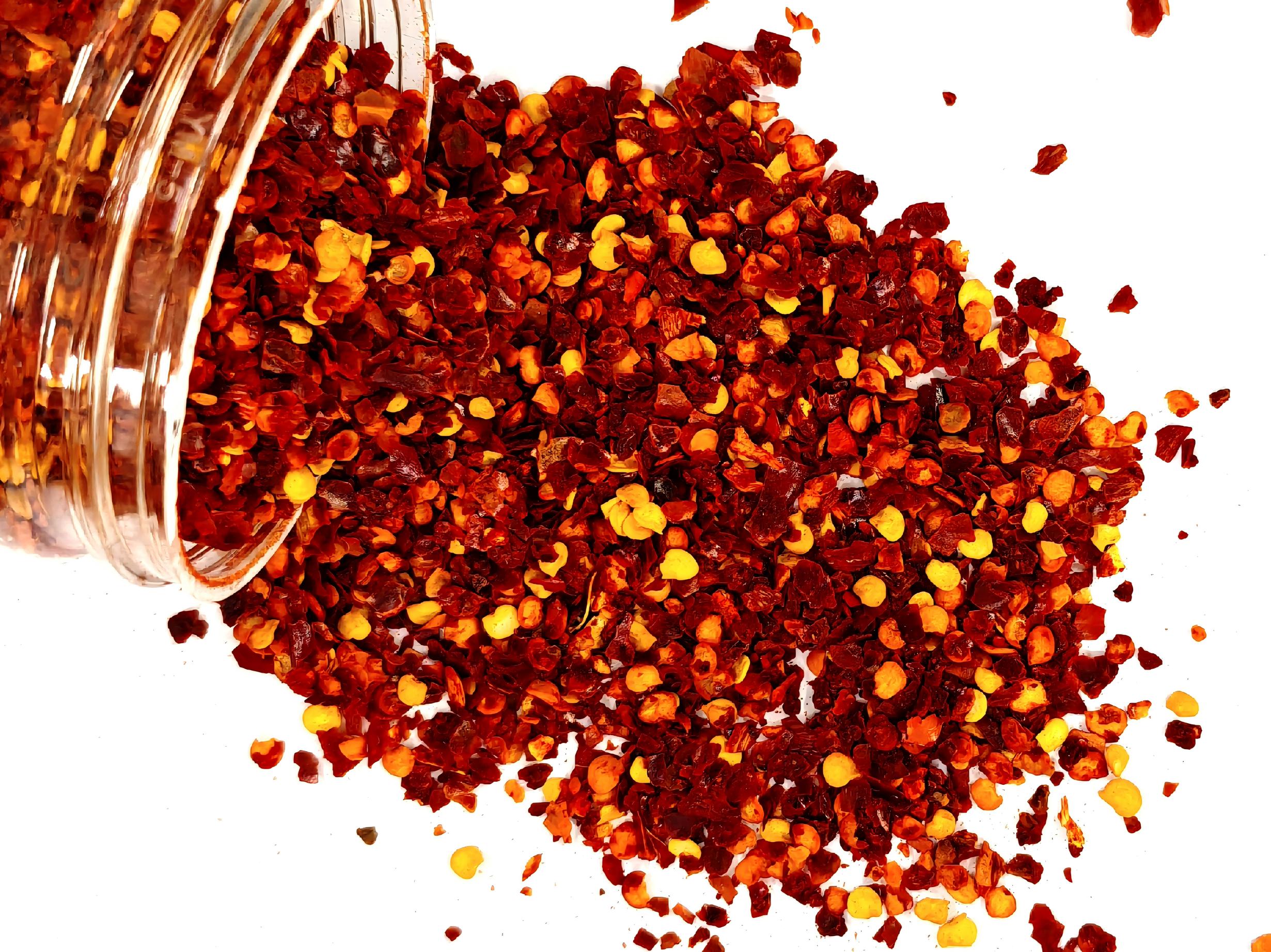
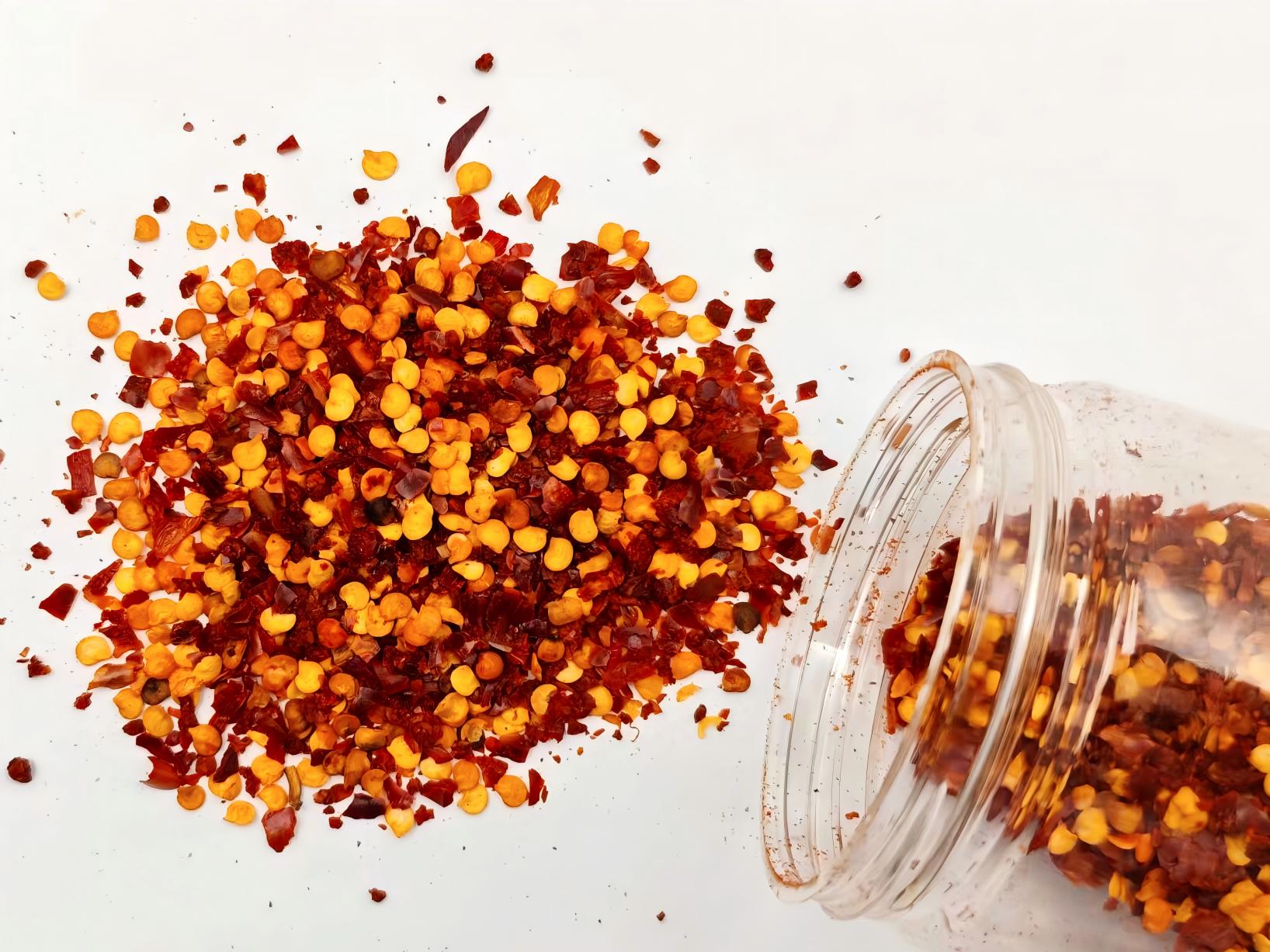
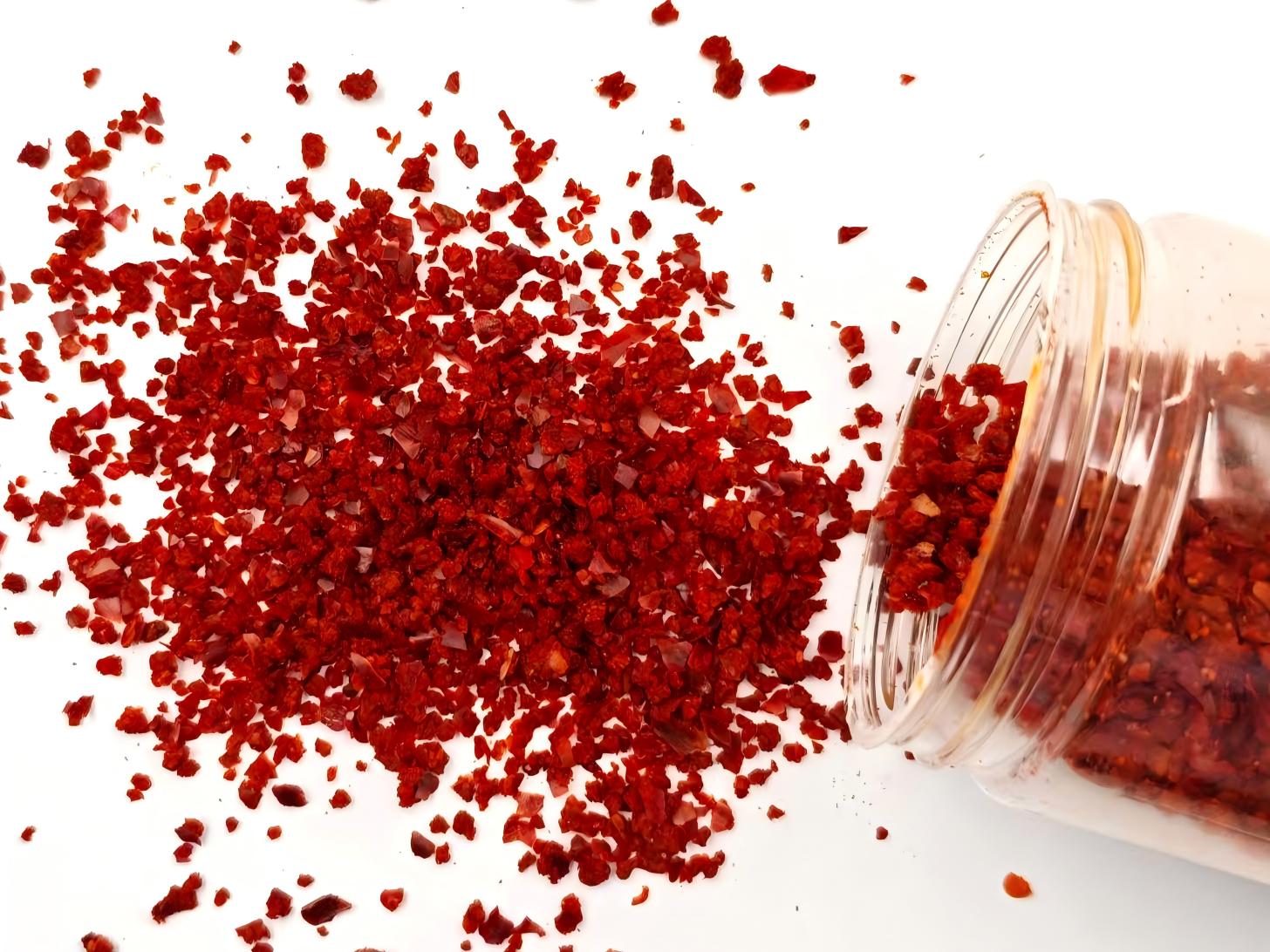
ASTA 120–140: copos de pimentón (dulce/suave) de primera calidad. Proveedor a granel de China
Descargar la ficha técnica de pimentón en copos de primera calidad
Las escamas de pimentón ASTA 120–140 son un ingrediente deshidratado de pimentón de calidad de exportación muy extendido, diseñado para la producción alimentaria industrial y los fabricantes de condimentos. Procedente principalmente de Xinjiang y Gansu, en China, o de cultivos controlados de variedades húngaras, este grado ofrece una combinación equilibrada de color rojo intenso, un perfil de picante suave y estabilidad en el precio.
Como fabricantes y exportadores de pimentón, vemos a menudo que las empresas de procesamiento alimentario de mediana y gran escala eligen este grado, ya que necesitan un rendimiento cromático constante pero deben controlar el coste de la fórmula por tonelada. A diferencia de las escamas de mayor calidad (ASTA 160-200), que suelen utilizarse en productos de gama alta o en aplicaciones que exigen un alto nivel de color, el grado ASTA 120-140 es el “grado más utilizado” en la producción mundial de condimentos.
En los mercados de exportación, muchos compradores eligen este grado cuando reformulan salchichas, mezclas de especias o bases para comidas instantáneas y necesitan un rendimiento predecible en lotes grandes. Un error habitual en la adquisición es especificar en exceso el grado ASTA 160+ para aplicaciones en las que el grado 120–140 ofrece un rendimiento idéntico tras la cocción, lo que provoca un aumento innecesario de los costes.
Este producto se suministra en envases de exportación de 10 a 25 kg con un pedido mínimo flexible (de 3 a 5 toneladas), lo que permite aplicar estrategias de aprovisionamiento tanto para cargamentos completos de contenedor como para envíos de prueba.
Las hojuelas de pimentón ASTA 120–140 son hojuelas de pimiento dulce o suave deshidratadas, de color medio, muy utilizadas en la fabricación industrial de alimentos. Las empresas de procesamiento alimentario las eligen por su rendimiento cromático equilibrado y su rentabilidad. Este grado se utiliza habitualmente en embutidos, mezclas de condimentos, salsas y platos preparados, donde se requiere un color rojo estable y una textura visible sin el coste adicional que suponen los grados con un índice ASTA elevado.
DESCRIPCIÓN GENERAL DEL PRODUCTO
Las escamas de pimentón ASTA 120–140 constituyen uno de los grados más equilibrados desde el punto de vista comercial en las cadenas de suministro de pimentón industrial. Desde el punto de vista de la producción, este grado se consigue controlando la madurez en el momento de la cosecha, la temperatura de secado y la consistencia de la molienda, con el fin de preservar una intensidad de color ASTA moderada y mantener al mismo tiempo la rentabilidad.
En PaprikaBulk.com, consideramos que este tipo de producto es un “pilar básico de la exportación” que se utiliza en toda Europa, Oriente Medio y América del Norte para la fabricación industrial de alimentos de gama media.
En los mercados de exportación, a menudo observamos que los compradores solicitan inicialmente grados ASTA más altos (160-200), partiendo de la premisa de que “cuanto más alto, mejor”. Sin embargo, una vez realizadas las pruebas de formulación, muchos fabricantes de alimentos optan por grados ASTA más bajos, entre 120 y 140, ya que la diferencia visual en los productos finales (especialmente en productos cocinados como salchichas, sopas y salsas) resulta insignificante, mientras que el ahorro de costes por tonelada puede alcanzar entre 8 y 20%.
Un error habitual en la adquisición de productos es pagar de más por una intensidad de color que se pierde durante el procesamiento térmico. Por ejemplo, en la producción de embutidos, los pigmentos del pimentón se degradan durante los ciclos de ahumado y cocción. Por ello, muchos procesadores de carne europeos se rigen por la norma ASTA 120-140 en lugar de optar por calidades superiores.
Desde el punto de vista de la relación calidad-precio, este grado se sitúa en la “zona de eficiencia óptima”. Los grados ASTA más bajos (80-100) suelen ser demasiado pálidos para los requisitos de las marcas de exportación, mientras que los grados ASTA más altos pueden no justificar su coste a menos que se utilicen en mezclas de condimentos secos en las que sea fundamental que se aprecien motas rojas visibles.
Otro factor importante es la estabilidad del suministro. El ASTA 120–140 se produce de forma generalizada en Xinjiang y Gansu debido a las condiciones favorables de secado y a la eficiencia del rendimiento, lo que hace que su precio sea menos volátil en comparación con los lotes especiales de alto ASTA.
La variación estacional también es un factor importante. Durante los meses de máxima cosecha, los compradores suelen adquirir este grado en contenedores (entre 8 y 14 toneladas por contenedor de 20 pies) para fijar los precios antes de que aumente la volatilidad tras la temporada.
ESPECIFICACIONES TÉCNICAS
| Parámetro | Especificaciones |
|---|---|
| Nombre del producto | Pimentón en copos dulce/suave |
| Valor de la ASTA | 120–140 |
| Tamaño de las partículas | 5 × 5 mm o 5–8 mm |
| Humedad | ≤ 8% |
| Contenido en cenizas | ≤ 6% |
| SO₂ | < 10 ppm (sin azufre) |
| Microbiología | TPC ≤ 50 000 ufc/g |
| Agentes patógenos | No se han detectado Salmonella ni E. coli |
| Esterilización | Vapor o irradiación (opcional) |
| Embalaje | Sacos de exportación de 10 kg a 25 kg |
| Vida útil | 24 meses |
| Origen | Xinjiang / Gansu, China |
| Cantidad mínima de pedido | 3-5 toneladas |
CARACTERÍSTICAS Y VENTAJAS PRINCIPALES
- Rendimiento cromático equilibrado según la norma ASTA 120–140 para garantizar la uniformidad industrial
- Más económico en comparación con los grados premium de alta ASTA
- Suministro estable procedente de las grandes zonas de cultivo chinas
- Adecuado tanto para perfiles de sabor dulce como para perfiles de picante suave
- Conserva la estructura laminar visible tras el tratamiento térmico
- Envases flexibles para mezclas destinadas al comercio minorista o para uso a granel
- Compatible con las normas de seguridad alimentaria de la UE
- Opción con bajo contenido en azufre para el posicionamiento de productos «clean label»
Cada una de estas características ayuda directamente a los compradores industriales a reducir el riesgo asociado a las formulaciones, mejorar la uniformidad de los lotes y optimizar el coste de los ingredientes.
GUÍA DEL COMPRADOR
A quién va dirigido:
- Fabricantes de embutidos y productos cárnicos
- Fabricantes de mezclas de especias
- Proveedores de condimentos para fideos instantáneos
- Fabricantes de comida preparada
- Empresas de envasado de especias (venta al por menor/marca blanca)
Quiénes NO deberían comprarlo:
- Marcas de especias gourmet de alta gama que requieren una intensidad visual de 160-200 según la escala ASTA
- Productos decorativos en forma de escamas para aplicación en frío que requieran un contraste rojo intenso
Lógica de adquisición:
Muchos compradores eligen la norma ASTA 120–140 como “calidad de producción de referencia”. A menudo se utiliza como especificación predeterminada en los contratos a largo plazo, ya que ofrece un equilibrio entre el color sensorial y la previsibilidad de los costes.
Perspectiva del sector:
En la fabricación de embutidos en Europa, es habitual que los equipos de compras estandaricen el uso de copos de pimentón en el rango ASTA 120-130, ya que cualquier valor superior a ese no mejora de forma significativa el aspecto del producto final tras el ahumado.
APLICACIONES
1. Elaboración de embutidos y carne
El ASTA 120–140 proporciona una dispersión estable en matrices cárnicas. Dosificación: 0,3–1,21 TP3T. Rara vez es necesario utilizar grados más altos de ASTA debido a su degradación por el calor.
2. Mezclas de especias
Se utiliza en mezclas de especias secas en las que se requiere una visibilidad moderada del color rojo. El control de costes es una de las principales razones por las que los compradores evitan el ASTA 160+.
3. Comidas preparadas y salsas
Aporta estabilidad al color de fondo en salsas y sopas a base de tomate.
4. Condimentos para aperitivos
Se utiliza en chips y frutos secos recubiertos en los que es importante que se vean las escamas, pero no se requiere una intensidad de color extrema.
Diferencias regionales:
- UE: prefiere un rango estandarizado de 120–140 para aplicaciones relacionadas con la carne
- Oriente Medio: ligera subida de la demanda de intensidad visual
- Sudeste asiático: más sensible al precio; a menudo se combina con ASTA 80–100
PERSPECTIVAS SOBRE LA CONTRATACIÓN PÚBLICA
En los ciclos de aprovisionamiento reales, el ASTA 120–140 suele adquirirse mediante contratos anuales que oscilan entre 1 y 5 contenedores por referencia. Los fabricantes más grandes pueden diversificar el abastecimiento entre varios orígenes para reducir el riesgo.
A menudo observamos tres comportamientos clave a la hora de comprar:
- Comportamiento de anclaje de precios: Los compradores comparan los precios con los del año pasado, en lugar de con el coste actual de las materias primas.
- Riesgo de especificación excesiva: Los nuevos compradores solicitan inicialmente el ASTA 160+ sin validación de la formulación.
- Estrategia de optimización de contenedores: Los compradores con experiencia agrupan varias referencias de especias en un único contenedor de 20 pies para reducir el coste logístico por kg.
Las fluctuaciones estacionales de los precios vienen determinadas por el rendimiento de la cosecha y las condiciones de secado. Las compras realizadas al final de la temporada suelen aumentar el coste entre un 5 y un 12%.
EXPLICACIÓN DEL VALOR ASTA
El ASTA mide la intensidad del color del extracto de pimentón y influye directamente en:
- Brillo visual de los alimentos elaborados
- Eficacia de la dosificación en las formulaciones
- Coste por unidad de color
Un valor de ASTA más alto implica más color por gramo, pero no siempre se traduce en un mejor rendimiento en los sistemas de cocción.
COMPARACIÓN DE GRADOS ASTA
| ASTA | Color | Solicitud | Nivel de costes | Tipo de comprador |
|---|---|---|---|---|
| 40–80 | Bajo | Mezclas económicas | Bajo | Empresas de transformación nacional/básica |
| 80–100 | Rojo claro | Condimentos económicos | Bajo | Compradores sensibles al precio |
| 120–140 | Rojo medio | Norma industrial | Medio | Empresas exportadoras |
| 140–160 | Rojo intenso | Mezclas de primera calidad | Medio-alto | Propietarios de marcas |
| 160–200 | Rojo intenso | Productos de alta visibilidad | Alto | Marcas de condimentos de primera calidad |
| 200–240 | Rojo intenso | Usos especializados | Muy alto | Mercados gourmet especializados |
PROCESO DE FABRICACIÓN
- Abastecimiento de pimiento crudo (Xinjiang, Gansu)
- Limpieza y eliminación de impurezas
- Clasificación por color y grado de madurez
- Secado controlado (al sol/en túnel de aire)
- Cortar en láminas de 5 a 8 mm
- Esterilización (vapor por defecto para cumplir con la normativa de la UE)
- Pruebas de calibración de la ASTA
- Detección de metales y análisis microbiológicos
- Embalaje apto para la exportación
CONTROL DE CALIDAD
- Pruebas con el espectrofotómetro de color ASTA
- Verificación de la humedad ≤ 8%
- Cumplimiento de las normas de seguridad microbiana
- Análisis de metales pesados (Pb, Cd, As)
- Control de los residuos de plaguicidas
- Sistema de trazabilidad por lotes
- Homogeneidad entre los lotes de cosecha de cada temporada
PERSPECTIVAS DEL SECTOR
- La mayoría de los compradores sobreestiman las necesidades de ASTA en un 20–40%
- La pérdida de color se produce principalmente durante el procesamiento térmico, no durante la producción.
- La humedad durante el almacenamiento supone un riesgo mayor que la exposición a la luz
- El pimentón procedente de Xinjiang suele ofrecer una mayor estabilidad del color de base.
- Los compradores europeos dan prioridad a la estabilidad frente a los valores máximos de la ASTA
INFORMACIÓN DE MERCADO
- Europa: alto grado de estandarización, contratos con precios estables
- Oriente Medio: gran demanda de intensidad de color
- África: uso de calidades mixtas, determinado por el precio
- Sudeste asiático: comportamiento de optimización del coste mínimo
- América Latina: creciente demanda de importaciones normalizadas
EXPORTACIÓN Y LOGÍSTICA
- Contenedor de 20 pies: entre 8 y 14 toneladas, dependiendo del embalaje
- Documentos de exportación: certificado de análisis (COA), certificado fitosanitario, certificado de origen
- Envase: sacos de papel kraft de 10 kg / 25 kg con revestimiento interior
- Estabilidad de la carga optimizada para el transporte de larga distancia
- No es necesario refrigerarlo
MUESTRAS Y DOCUMENTACIÓN
- Hay muestras gratuitas de productos disponibles (gastos de envío a cargo del destinatario)
- Certificado de análisis (COA) facilitado por lote
- Ficha técnica completa disponible
- Fotos de la producción y el embalaje disponibles bajo petición
- Se incluyen los documentos de cumplimiento de la normativa de exportación
¿POR QUÉ ELEGIR? PaprikaBulk.com
- Precios directos del fabricante (sin márgenes comerciales intermedios)
- Red estable de abastecimiento de materias primas
- Experiencia en exportación a los mercados de la UE, EE. UU. y Japón
- Cantidad mínima de pedido flexible para pedidos de prueba (3-5 toneladas)
- Consistencia entre lotes a lo largo de las cosechas estacionales
- Opciones personalizadas de tamaño de partícula y esterilización
- Capacidad de suministro mediante contratos a largo plazo
Preguntas frecuentes
1. ¿Por qué elegir ASTA 120–140 en lugar de 160+?
Porque en los sistemas de cocción, un valor ASTA más alto no mejora de forma significativa el rendimiento cromático final.
2. ¿Un valor más alto de ASTA siempre significa mejor calidad?
No, depende de la aplicación y del tratamiento térmico.
3. ¿Es adecuado para la elaboración de embutidos?
Sí, se utiliza ampliamente en la industria cárnica europea.
4. ¿Cuál es el principal factor que influye en los costes?
Calidad de la pimienta en bruto y rendimiento del secado.
5. ¿Se puede personalizar ASTA?
Sí, mediante el control de las mezclas y la clasificación.
6. ¿Se degrada el color con el paso del tiempo?
Sí, sobre todo debido a la exposición al calor y a la humedad.
7. ¿Cuál es la cantidad mínima de pedido habitual?
Entre 3 y 5 toneladas, dependiendo del destino.
8. ¿Es necesaria la esterilización con vapor?
En la mayoría de los casos, es obligatorio para cumplir con la normativa de la UE.
9. ¿Puedo mezclar diferentes grados de ASTA?
Sí, es habitual en las estrategias de optimización de costes.
10. ¿Por qué es competitivo el pimentón chino?
Producción a gran escala y un entorno de secado estable.
11. ¿En qué sectores se utiliza más?
Elaboración de productos cárnicos y fabricación de condimentos.
12. ¿Influye el tamaño de los copos en el precio?
Sí, la estandarización de las tallas aumenta los costes de procesamiento.
13. ¿Se utiliza azufre?
No, este tipo de combustible no contiene azufre.
14. ¿Cuál es el plazo de conservación?
24 meses si se conserva en condiciones adecuadas.
15. ¿Puedo recibir muestras antes de hacer el pedido?
Sí, hay muestras disponibles para realizar pruebas.
Para cuestiones relacionadas con las compras, la validación técnica o los precios de los contenedores:
- Solicita muestras gratuitas
- Solicitar el certificado de origen y la ficha técnica
- Consulta los precios al por mayor (FOB/CIF)
- Analizar los contratos de suministro anuales
- Optimiza el grado ASTA de tu formulación
- Solicitar presupuesto para un contenedor completo