
Usine de transformation industrielle du paprika : processus de production de pointe et contrôles qualité
Une description technique détaillée du système automatisé de Dinweys® Qingdao, HACCP- des processus de broyage et de raffinage du piment conformes aux normes, ainsi que des flux de travail d'exportation suivis par le système MES.
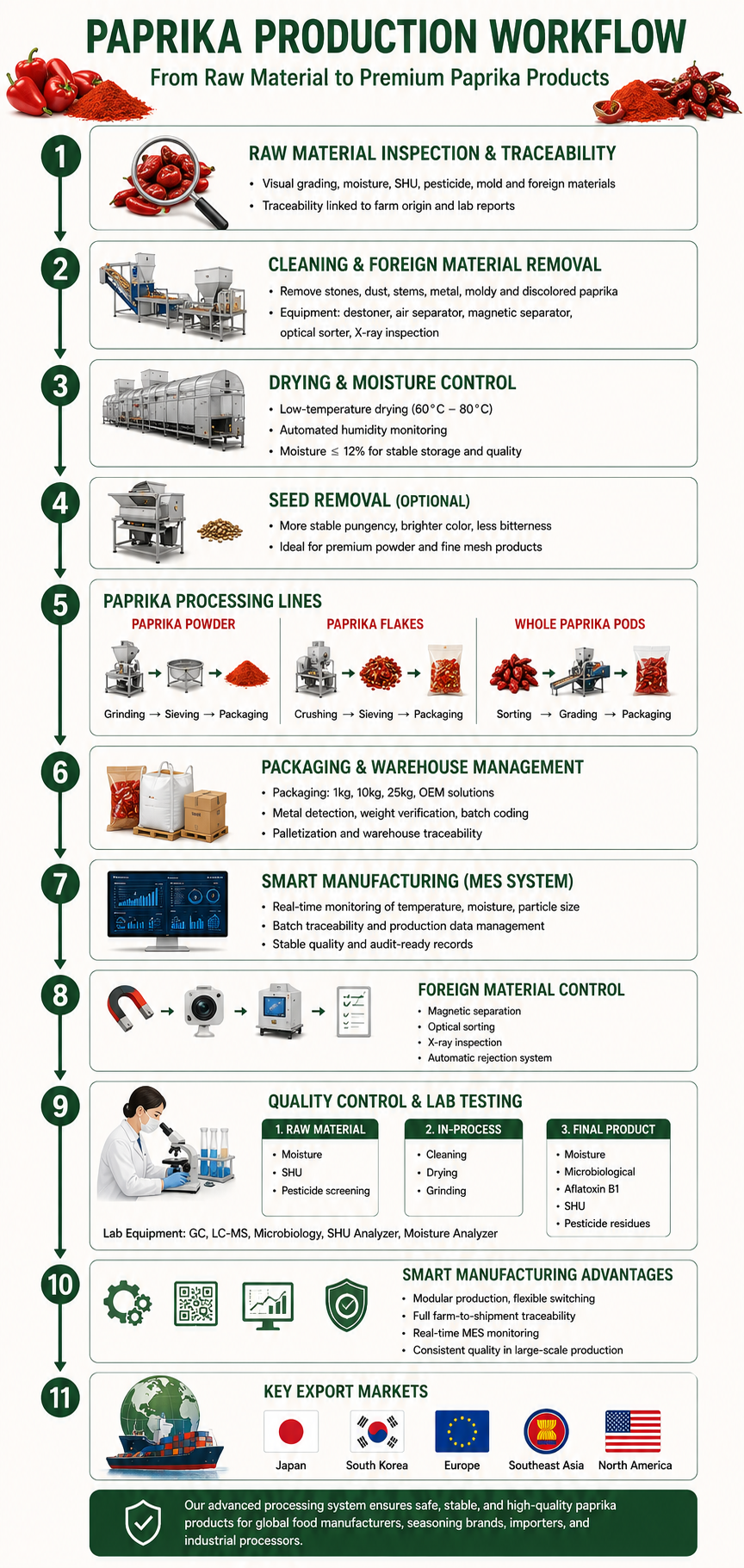
1. Cadre de traitement intégré
Nos lignes de production modulaires permettent une transition fluide entre les différents poudre, structuré flocons, et entier gousses tout en utilisant un système MES (Manufacturing Execution System) intelligent pour surveiller les points de contrôle critiques (PCC).
Ligne A : Paprika en poudre de qualité supérieure (60–120 mesh)
Réception des matières premières → Tamisage en plusieurs étapes → Déshydratation thermique (60 °C–80 °C) → Séparation précise des graines → Broyage à l'air ultrafin → Détection et rejet des contaminants par rayons X → Conditionnement en vrac automatisé
Avantage technique : Nos circuits de broyage à basse température empêchent les pigments naturels de capsanthine de se dégrader sous l'effet de la friction thermique, garantissant ainsi que la poudre finale conserve ses propriétés d'origine Valeur de couleur ASTA et des huiles aromatiques volatiles.
Ligne B : Flocons de paprika uniformes (broyés, 3–8 mm)
Réception des cosses brutes → Retrait pneumatique des tiges → Broyage mécanique contrôlé → Tamisage vibratoire multicouche → Tri optique par infrarouge → Séparation magnétique des métaux → Scellage des conteneurs industriels
Avantage technique : Spécialement conçu pour la texturation visuelle des produits carnés haut de gamme et des assaisonnements pour snacks, garantissant un rapport bris/poussière réduit au strict minimum.
Ligne C : Flux de poivrons entiers destinés à l'exportation
Étalonnage sensoriel manuel → Nettoyage par jet d'air → Stabilisation de l'humidité (≤12%) → Tri optique par couleur → Stérilisation → Mise en balles sous vide
Avantage technique : Préserve la structure cellulaire des gousses dans son intégralité, garantissant une variation minimale du taux d'humidité et une hygiène structurelle optimale pour les moulins situés à l'étranger.
2. Sécurité alimentaire critique et intervention en cas de présence de corps étrangers
Schéma général du processus de purification physique
Matières premières entrantes → Dépierrement par vibration (séparation par densité) → Séparation magnétique (élimination des métaux ferreux) → Tri optique par infrarouge (détection des défauts de couleur) → Inspection par rayons X (détection des corps étrangers à haute densité) → Sortie conforme aux normes alimentaires 100%
Afin de respecter les normes d'importation extrêmement strictes interdisant toute présence de corps étrangers Le Japon, la Corée du Sud et l'Union européenne, Dinweys® utilise une matrice d'élimination des risques physiques à plusieurs niveaux :
- Dépierreuses vibrantes et séparateurs à air : Séparer instantanément les débris de champ volumineux, les cailloux, la terre et les résidus végétaux (tiges/feuilles).
- Cascades magnétiques des terres rares : Isoler et récupérer les fragments microscopiques de métaux ferreux et non ferreux lors de la phase de tamisage intensif.
- Systèmes de tri optique par infrarouge et à rayons X : Des algorithmes de détection en temps réel rejettent automatiquement les cosses décolorées ou attaquées par la moisissure, ainsi que les particules de plastique, de verre ou de pierre dissimulées dans le flux de produit.
3. Validation en laboratoire en trois étapes
Chaque lot de production se voit attribuer une trace numérique localisée, qui relie directement les codes-barres des palettes finales aux données de chromatographie GC-MS et LC-MS recueillies sur site.
Phase I : Contrôle à l'entrée : Les piments crus sont soumis à des contrôles rigoureux Criblage par GC-MS/MS pour la détection des résidus de pesticides, la vérification de la teneur en humidité à l'aide d'analyseurs halogènes de précision et l'étalonnage de l'échelle de Scoville (SHU).
Phase II : Contrôles en cours de fabrication : Des boucles PLC automatisées ajustent en permanence les températures de séchage entre 60 °C et 80 °C, empêchant ainsi la rétention d'humidité d'atteindre le seuil critique < 11,01 TP3T (ou < 10,01 TP3T selon les spécifications du maillage) seuil de conformité.
Phase III : Formalités de sortie : Les essais finaux permettent de vérifier l'absence totale de Aflatoxine B1, ochratoxine A et Salmonelle avant la validation de l'emballage et de l'expédition.
Foire aux questions
Q : Pourquoi Dinweys® utilise-t-il un système de broyage à basse température spécialement conçu pour la poudre de paprika ?
R : Le broyage traditionnel à grande vitesse génère une chaleur de friction intense dépassant les 146 °C, ce qui provoque une dégradation thermique rapide de la capsanthine, entraînant la paprika’La valeur ASTA de la couleur s'estompe, tout comme son arôme naturel. Notre ligne de broyage modulaire à basse température stabilise les lots de broyage, en préservant parfaitement la densité naturelle des pigments rouges et les huiles essentielles volatiles requises par les mélangeurs industriels d'assaisonnements.
Q : En quoi le processus optionnel d'élimination des pépins présente-t-il un intérêt pour les industriels de l'agroalimentaire ?
R : Les graines de paprika contiennent des lipides et une légère amertume qui peuvent modifier le profil gustatif et atténuer l'éclat de la couleur. En utilisant séparateurs de graines automatisés, nous pouvons épépiner partiellement ou entièrement les gousses avant la mouture. Pour les acheteurs au Japon, en Corée du Sud et dans les secteurs culinaires haut de gamme, cette personnalisation améliore considérablement la saturation des couleurs (rouge plus vif) et garantit une stabilité absolue des valeurs de piquant (SHU).
Q : Comment votre chaîne de production est-elle organisée pour faciliter la conformité aux réglementations internationales ?
R : Nos chaînes de production sont gérées via un système centralisé Plateforme d'exécution numérique MES. Cela signifie que des paramètres tels que la taille des particules, la tolérance à l'humidité et les étapes d'intervention microbiologique sont entièrement personnalisés pour chaque commande. Lorsqu'un lot est destiné à l'UE ou à l'Amérique du Nord, le système le signale automatiquement et configure la chaîne de production de manière à respecter les paramètres internationaux de sécurité alimentaire correspondants, créant ainsi un une trace écrite immédiate et prête pour un audit destiné aux responsables de la conformité à l'étranger.