Especificaciones microbiológicas del pimentón para la fabricación industrial de alimentos
TPC, levaduras y mohos, agentes patógenos, micotoxinas y normas de cumplimiento internacionales
En las cadenas de suministro mundiales de ingredientes alimentarios, pimentón especificaciones microbiológicas son un factor determinante para el cumplimiento de las normas de seguridad alimentaria, la idoneidad para la exportación y la cualificación de los proveedores.
Para los compradores industriales que adquieren pimentón a granel en PaprikaBulk.com, la calidad microbiológica no es solo un requisito de la ficha técnica, sino que influye directamente en:
- Despacho de aduanas de importación entre la UE y EE. UU.
- Resultados de la auditoría de seguridad alimentaria (HACCP / FSMA / BRCGS)
- Riesgo de responsabilidad por productos defectuosos
- Estabilidad del producto final en el punto de venta
Aunque el pimentón es un ingrediente de especias con bajo contenido en humedad, baja actividad del agua (aw < 0,60) no significa esterilidad. Por el contrario, las especias actúan como portadores microbianos en estado de latencia, que pueden reactivarse al introducirse en sistemas alimentarios con un alto contenido de humedad.
1. Límites microbiológicos estándar para el pimentón (parámetros de referencia del sector)
Las normas internacionales sobre especias vienen definidas por:
- Asociación Europea de Especias (ESA)
- Asociación Americana del Comercio de Especias (ASTA)
- Códice Alimentario
- Normas ISO sobre microbiología
Especificaciones microbiológicas del pimentón
| Parámetro | Límite de calidad comercial | Exportación / Premium (esterilizado al vapor) | Método ISO |
|---|---|---|---|
| Recuento total de gérmenes (TPC / APC) | < 1 000 000 UFC/g | < 100 000 UFC/g | ISO 4833-1 |
| Levaduras y mohos | < 10 000 UFC/g | < 1.000 UFC/g | ISO 21527-2 |
| Enterobacteriaceae | < 1.000 UFC/g | < 100 UFC/g | ISO 21528-2 |
| E. coli | < 10 UFC/g | Ausente en 1 g | ISO 16649-2 |
| Salmonella spp. | Ausente en 25 g | Ausente en 25 g (n = 10, c = 0) | ISO 6579-1 |
| Bacillus cereus | < 1.000 UFC/g | < 100 UFC/g | ISO 7932 |
En lo que respecta al comercio internacional, La ausencia de salmonela es el requisito normativo imprescindible., mientras que otros parámetros definen la higiene y la calidad del proceso.
2. ¿Por qué el pimentón tiene, por naturaleza, un mayor recuento microbiano?
El pimentón es un producto agrícola de origen especiado que se somete a:
- Cultivo al aire libre
- Cosecha mecánica o manual
- Secado al sol o deshidratación a baja temperatura
- Pasos mínimos de eliminación en el posprocesamiento
Por este motivo, los recuentos microbiológicos de:
10⁴–10⁶ UFC/g (TPC)
se consideran indicadores de estado normal y de ausencia de deterioro.
Dato importante:
La carga microbiana en las especias no equivale a un riesgo para la seguridad. El factor decisivo es:
- Ausencia de patógenos (especialmente Salmonella)
- Indicadores de higiene (niveles de enterobacterias)
3. La paradoja de la seguridad alimentaria en los alimentos con bajo contenido en humedad
Una idea errónea muy extendida en el ámbito de la adquisición de alimentos es:
“Las especias secas son seguras por naturaleza”
Esto es incorrecto.
Aunque el pimentón tiene una baja actividad del agua (aw < 0,60), los microorganismos no se eliminan, sino que conservado en estado de latencia.
Existe riesgo cuando se utiliza pimentón en:
- Emulsiones cárnicas (embutidos, fiambres)
- Salsas líquidas y adobos
- Sistemas de condimentos listos para consumir
- Aplicaciones en aperitivos recubiertos
Mecanismo de riesgo:
Los microorganismos en estado de latencia pueden:
- Se reactiva al hidratarse
- Resistir en entornos ácidos o con temperaturas moderadas
- Multiplicarse en sistemas ricos en nutrientes
4. Patógenos frente a organismos indicadores
El análisis microbiológico de las especias se divide en dos categorías:
Organismos patógenos (tolerancia cero)
- Salmonella spp. → Debe estar ausente
- E. coli → Indicador de riesgo de contaminación fecal
- Clostridium perfringens → Peligro por formación de esporas
Organismos indicadores (calidad higiénica)
Enterobacteriaceae
- Indica el nivel de higiene de la materia prima
- Los niveles elevados indican una higiene deficiente durante el secado o la presencia de contaminación.
Levaduras y mohos
- Indica humedad en el almacenamiento o secado retrasado
Recuento total de gérmenes (TPC)
- Indicador de la carga microbiana total
- No está directamente relacionado con el riesgo para la seguridad alimentaria
5. Riesgo de micotoxinas en el pimentón (factor crítico de cumplimiento)
Además de los riesgos microbiológicos, el pimentón es muy sensible a contaminación por toxinas fúngicas (micotoxinas).
Principales contaminantes:
- Aflatoxinas (B1, B2, G1, G2)
- Ocratoxina A (OTA)
Límites reglamentarios:
Unión Europea (la más estricta)
- Aflatoxina B1: < 5 µg/kg
- Aflatoxinas totales: < 10 µg/kg
- OTA: < 15 µg/kg
Estados Unidos (FDA)
- Aflatoxinas totales: < 20 µg/kg
Las micotoxinas son estable al calor, lo que significa que NO se eliminan mediante esterilización con vapor.
6. Sistema de muestreo microbiológico ICMSF (norma industrial)
Los compradores industriales se basan en el muestreo estadístico en lugar de en ensayos puntuales.
Modelo básico:
(n, c, m, M)
Dónde:
- n = número de muestras
- c = resultados marginales aceptables
- m = umbral aceptable
- M = límite de rechazo
Ejemplo:
En el caso de la salmonela:
- n=10, c=0 → modelo de tolerancia cero
En el caso del Bacillus cereus:
- El modelo de tres clases permite la variación natural en la agricultura
Esto garantiza que fiabilidad estadística en las decisiones de aprobación de lotes.
7. Métodos de descontaminación industrial
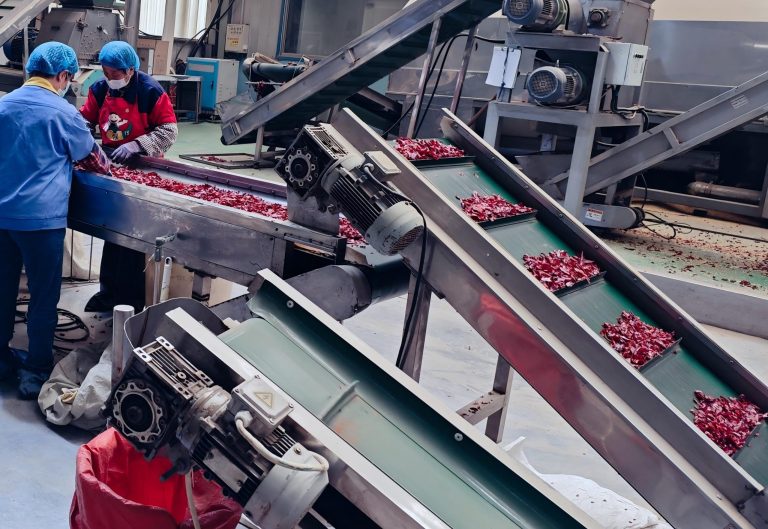
Para cumplir con las normas de exportación, el pimentón debe someterse a un proceso validado de reducción microbiana.
Esterilización al vapor (norma del sector)
- Vapor saturado a 102–105 °C
- Exposición de 15 a 30 segundos
- Reducción microbiana de 3 a 5 log
- Ligera pérdida de color (pérdida de 5 a 101 TP3T según la escala ASTA)
Irradiación gamma
- 5–10 kGy
- Reducción de 5 a 7 log
- Pérdida mínima de color
- Etiquetado obligatorio en la UE
Óxido de etileno (EtO)
- Restringido/prohibido en la UE
- Límites de residuos regulados en EE. UU.
8. Riesgo microbiano frente a calidad del color (compromiso de la ASTA)
| Tratamiento | Reducción microbiana | Impacto de ASTA | Impacto aromático |
|---|---|---|---|
| Sin tratamiento | Bajo | Ninguno | Aroma intenso |
| Esterilización al vapor | Alto (3–5 log) | Pérdida media | Ligera reducción |
| Irradiación gamma | Muy alto (5–7 log) | Mínimo | Neutro |
| Procesamiento excesivo | Excesivo | Degradación grave | Notas quemadas |
Pimentón industrial producción es un equilibrio controlado entre la seguridad y la calidad sensorial.
9. Factores de riesgo de la cadena de suministro (lista de comprobación para el comprador)
A la hora de evaluar a los proveedores de pimentón, los responsables de control de calidad deben comprobar lo siguiente:
✔ Cumplimiento de los requisitos microbiológicos
- Informes de laboratorio según la norma ISO 17025
- Confirmación de resultado negativo para Salmonella
- Niveles de Enterobacteriaceae
✔ Validación de la esterilización
- Verificación de la reducción de 5 log
- Sustituto del proceso (E. faecium)
✔ Integridad del embalaje
- Bolsas multicapa con barrera contra la humedad
- Transporte controlado de humedad
✔ Seguridad química
- Análisis de aflatoxinas
- Metales pesados (plomo, cadmio)
10. Sistema de garantía de calidad de PaprikaBulk.com
PaprikaBulk.com aplica un control de calidad de nivel industrial que incluye:
- Análisis microbiológicos por lote
- Verificación de un laboratorio acreditado según la norma ISO 17025
- Protocolos de validación de la esterilización con vapor
- Documentación completa del certificado de origen (COA) para cada envío
- Armonización de los requisitos de cumplimiento en materia de exportación entre la UE y la FDA
11. Preguntas frecuentes (FAQ)
Pregunta 1. ¿El pimentón es estéril por naturaleza?
No. El pimentón es no es un ingrediente alimentario estéril, aunque se clasifique como un alimento de baja humedad. Durante el cultivo, la cosecha, el secado y la molienda, el pimentón queda expuesto de forma natural a los microorganismos del suelo, al polvo en suspensión y a la microflora ambiental. Si bien su baja actividad de agua (normalmente aw < 0,60) impide que los microorganismos crezcan activamente durante el almacenamiento, muchas bacterias, levaduras, mohos y esporas bacterianas permanecen viables en estado latente. Por eso, el pimentón destinado a la exportación se somete habitualmente a análisis para detectar patógenos como Salmonella y Escherichia coli, y por qué muchos fabricantes de alimentos especifican el pimentón esterilizado al vapor para aplicaciones de productos listos para el consumo.
Pregunta 2. ¿Cuál es el análisis microbiológico más importante para el pimentón?
El requisito microbiológico más importante es el ausencia de Salmonella spp. en 25 g de producto. Las autoridades reguladoras de la Unión Europea, Estados Unidos y muchos otros mercados internacionales aplican una política de tolerancia cero porque Salmonella puede sobrevivir durante largos periodos de tiempo en las especias secas y puede contaminar los alimentos elaborados tras su rehidratación. Aunque el recuento total de gérmenes (TPC), las levaduras y los mohos, y las enterobacterias son indicadores importantes de la higiene en el procesamiento, el incumplimiento de los Salmonella El incumplimiento de este requisito suele dar lugar al rechazo inmediato del envío, a la retirada del producto o a la denegación de la importación.
Pregunta 3. ¿Por qué se considera que las enterobacterias son un indicador de calidad importante?
Las Enterobacteriaceae se utilizan ampliamente como indicador de higiene del proceso más que un criterio directo de seguridad alimentaria. Un recuento elevado puede sugerir una contaminación durante la recolección, el secado, la molienda o el envasado, y puede indicar unas condiciones de higiene inadecuadas, unas condiciones de secado deficientes, agua de riego contaminada o contaminación cruzada tras el procesamiento. Aunque muchos miembros de esta familia bacteriana son organismos ambientales inofensivos, unos recuentos de enterobacterias sistemáticamente bajos demuestran que un proveedor mantiene unas buenas prácticas de fabricación (BPF) eficaces, unos procedimientos de higiene adecuados y una manipulación controlada tras la cosecha.
Pregunta 4. ¿La esterilización con vapor elimina todos los riesgos microbiológicos y químicos?
No. La esterilización con vapor es muy eficaz para reducir las bacterias, las levaduras, los mohos y los patógenos, y suele alcanzar una Reducción microbiana de 3 a 5 log en condiciones de procesamiento validadas. Sin embargo, esto no elimina los contaminantes químicos resistentes al calor, incluidas las aflatoxinas y la ocratoxina A que puedan haberse formado antes de la transformación. Por este motivo, los proveedores de pimentón de primera calidad combinan una esterilización al vapor validada con una rigurosa selección de la materia prima, un secado rápido, controles de higiene ambiental y análisis de laboratorio rutinarios tanto de parámetros microbiológicos como de micotoxinas, con el fin de garantizar una seguridad alimentaria integral.
Pregunta 5. ¿Cuál se considera un recuento total de gérmenes (TPC) aceptable para el pimentón?
En el caso del pimentón comercial sin tratar, el recuento total de gérmenes es de hasta 1 000 000 UFC/g (10⁶ UFC/g) Por lo general, se considera aceptable según muchas especificaciones del sector, ya que el pimentón es un producto agrícola y no un ingrediente estéril. El pimentón de primera calidad para exportación o esterilizado al vapor suele presentarse con recuentos mucho más bajos, normalmente por debajo de 100 000 UFC/g, y en algunas especificaciones de los clientes que figuran a continuación 50 000 UFC/g. Es importante señalar que el TPC por sí solo no determina la seguridad alimentaria; la ausencia de patógenos, especialmente Salmonella, es considerablemente más importante que el recuento total de bacterias aeróbicas.
Pregunta 6. ¿Por qué el pimentón seco puede seguir planteando problemas de seguridad alimentaria?
El secado impide que los microorganismos se multipliquen, pero sí no tiene por qué matarlos. Muchas bacterias, sobre todo las especies que forman esporas, como Bacillus cereus, pueden sobrevivir en el pimentón seco durante largos periodos de tiempo. Una vez que el pimentón se añade a alimentos con un mayor contenido de humedad —como salsas, sopas, adobos, embutidos o platos preparados—, estos microorganismos latentes pueden volver a activarse metabólicamente si el procesamiento posterior es inadecuado. Por este motivo, las especificaciones microbiológicas son especialmente importantes para los ingredientes utilizados en productos que no se someten a una etapa adicional de eliminación de microorganismos validada.
P7. ¿Por qué muchos fabricantes de productos alimenticios especifican que el pimentón se haya esterilizado al vapor?
La esterilización al vapor reduce significativamente las poblaciones microbianas, al tiempo que conserva la mayor parte del color, el sabor y la calidad nutricional naturales del pimentón. Es el método de descontaminación no químico preferido por muchos fabricantes internacionales de alimentos, ya que permite cumplir con los programas de seguridad alimentaria HACCP, BRCGS, SQF y FSMA. En comparación con el pimentón sin tratar, los productos esterilizados al vapor presentan un menor riesgo microbiológico y se utilizan ampliamente en alimentos listos para el consumo, mezclas de condimentos, procesamiento cárnico, productos lácteos, recubrimientos de aperitivos y alimentos precocinados, donde el control de los patógenos es fundamental.
Pregunta 8. ¿Qué documentos deben solicitar los compradores antes de adquirir pimentón a granel?
Los compradores profesionales deberían solicitar un informe exhaustivo Certificado de análisis (COA) para cada lote de producción. Un certificado de análisis completo suele incluir el recuento total de gérmenes, levaduras y mohos, enterobacterias, Escherichia coli, Salmonella, contenido de humedad, valor de color según la ASTA, resultados de residuos de plaguicidas, análisis de metales pesados y análisis de micotoxinas. Los compradores también pueden solicitar información sobre la acreditación de los laboratorios (como la norma ISO/IEC 17025), registros de validación de la esterilización, documentación sobre la trazabilidad de los lotes y certificaciones de gestión de la calidad, como la norma ISO 22000, el sistema HACCP o la norma BRCGS, en función de sus requisitos normativos.
12. Conclusión
Las especificaciones microbiológicas definen el auténtica calidad industrial del pimentón más allá del color (ASTA) y el sabor.
Para los fabricantes de productos alimenticios a nivel mundial, la elección de un proveedor que:
- Sistemas de control microbiano validados
- Pruebas ISO documentadas
- Procesos de descontaminación controlados
- Total transparencia en el COA
es fundamental para reducir el riesgo de incumplimiento normativo y garantizar el acceso a los mercados internacionales.