القيمة الغذائية لمسحوق البابريكا: دليل تقني لمصنعي الأغذية الصناعية
author: “Senior Food Technologist, Spice Processing R&D”
date: “2026-07-10”
القيمة الغذائية لمسحوق البابريكا: دليل تقني لمصنعي الأغذية الصناعية
باختصار: Paprika powder is one of the most nutritionally dense spices available industrially — delivering high concentrations of vitamin A (provitamin A carotenoids: 2,463 µg RAE/100g), vitamin E (29.1 mg/100g), vitamin B6 (2.1 mg/100g), and a rich profile of antioxidant carotenoids (capsanthin, zeaxanthin, beta-carotene) [Source: USDA FoodData Central, SR Legacy, 2024]. However, 40–60% of these sensitive compounds can degrade during conventional hot-air drying and milling [Source: Journal of Food Processing & Preservation, 2020]. Industrial buyers sourcing from China — the world’s largest paprika powder exporter — need to understand how processing parameters, drying method, and milling temperature directly affect the nutritional specs they’re paying for.
The Carotenoid Chemistry: Why Processing Temperature Matters at the Molecular Level
Before we dive into tables and specs, let’s look at what’s actually happening at the molecular level when paprika is processed. Understanding this chemistry is the difference between buying on price and buying on value.
Paprika’s red color — and its provitamin A activity — comes from a family of tetraterpenoid pigments called carotenoids. The dominant compound in paprika is الكابسانثين (C₄₀H₅₆O₃), a unique carotenoid that accounts for 30–60% of the total pigment content in ripe red peppers [Source: Journal of Food Science, 2018].
The problem: capsanthin contains a conjugated double-bond system with 11–13 double bonds. Every one of those double bonds is a site for oxidation and isomerization. When heat is applied:
- Isomerization — the all-trans configuration (which gives the strongest red color and highest vitamin A activity) converts to cis-isomers (weaker color, lower bioavailability). This starts happening noticeably above 60°C.
- الأكسدة — oxygen attacks the double-bond system, cleaving the molecule into smaller fragments that have neither color nor nutritional activity. Light accelerates this process dramatically.
- Thermal degradation — at temperatures above 80°C, the carbon backbone itself begins to break down.
The temperature-activity relationship: For every 10°C increase in processing temperature above 50°C, the degradation rate of capsanthin roughly doubles [Source: Arrhenius kinetics modeling, Food Chemistry, 2020]. This means a 70°C drying process degrades carotenoids roughly 4x faster than a 50°C process.
A factory manager I worked with in Xinjiang once told me: “Our farmers think faster drying is better drying. They turn the heat up to 80°C and get the moisture out in 6 hours. But they’re burning off 30% of the color — and 30% of the nutritional value — to save 3 hours.”
That’s the fundamental tension in industrial paprika processing: speed versus nutritional preservation. The best processors have figured out how to optimize both.
Key Statistics
- Global spice paprika الإنتاج: approximately 800,000–900,000 MT/year, with China contributing 35–40% of global output [Source: FAO Stat, 2024]
- China exported approximately 125,000 MT of ground paprika and chili products in 2024, primarily from Shandong, Xinjiang, and Gansu provinces [Source: China Customs Statistics, 2024]
- Paprika powder ranks as the 2nd most consumed spice globally by volume, behind only black pepper [Source: Spices Board India, 2024]
- ASTA color value correlates with total carotenoid content at R² = 0.92 in controlled studies [Source: Journal of Agricultural and Food Chemistry, 2019]
- Typical drying losses of ascorbic acid in paprika range from 55% to 85%, depending on drying method [Source: LWT – Food Science and Technology, 2021]
- Over 70% of industrial paprika powder is used in meat processing, snack seasonings, and sauce manufacturing [Source: Tridge Supply Chain Analysis, 2025]
- The global spice paprika market is valued at $1.8 billion (2025) and growing at 4.2% CAGR [Source: Mordor Intelligence, 2025]
مقدمة
Most articles about paprika powder nutrition are written for home cooks. They tell you how many micrograms of vitamin A are in a teaspoon, or why you should sprinkle paprika on your eggs.
This isn’t that article.
If you’re sourcing paprika powder for industrial food manufacturing — meat processing, snack seasonings, sauce formulations, or spice blends — the nutritional profile matters differently. You’re not just adding flavor and color. You’re procuring a concentrated ingredient that carries provitamin A carotenoids, tocopherols, essential minerals, and antioxidant capacity into your finished product. And how that ingredient was grown, dried, milled, and stored determines whether those nutritional properties survive the supply chain.
I’ve spent the last 12 years working in spice processing R&D — running drying trials, optimizing milling parameters, and auditing paprika processing facilities across China, Spain, and the US. This guide covers what I’ve learned about paprika powder nutrition from an industrial perspective: the compounds that matter, how processing affects them, what specs to specify, and why China has become the dominant global supplier for nutritionally competitive paprika ingredients.
The Nutritional Profile of Paprika Powder: What the Lab Data Shows
Let’s start with the numbers that matter for industrial formulation.
Complete Nutritional Composition (Per 100g)
| Nutrient | Amount per 100g | % Daily Value | Industrial relevance |
|---|---|---|---|
| Energy | 282 kcal | 14% | Low relative to usage level (0.5–3% of formulation) |
| Protein | 14.1 g | 28% | Contributes to Maillard browning in processed meats |
| Total Fat | 12.9 g | 20% | Carrier for oil-soluble carotenoids |
| Carbohydrates | 54.0 g | 20% | Including ~21 g dietary fiber |
| Dietary Fiber | 20.9 g | 84% | Minor contributor in most industrial applications |
| Vitamin A (RAE) | 2,463 µg | 274% | Primary nutritional value driver; derives from carotenoids |
| Vitamin E (alpha-tocopherol) | 29.1 mg | 194% | Antioxidant; protects color stability in blends |
| Vitamin B6 | 2.1 mg | 123% | Stable during processing |
| فيتامين ج | 0.9 mg | 1% | Heavily degraded during drying; NOT a reliable source in processed paprika |
| Niacin (B3) | 10.1 mg | 63% | Stable; contributes to nutritional labeling |
| Riboflavin (B2) | 1.2 mg | 92% | Stable |
| الحديد | 21.1 mg | 117% | Significant mineral contribution in high-inclusion applications |
| Potassium | 2,280 mg | 48% | Relevant for low-K diet formulations |
| Magnesium | 178 mg | 42% | Stable mineral |
| Sodium | 34 mg | 1% | Naturally very low — excellent for clean label |
| Capsaicin (hot varieties) | 0–46 mg | — | Pungency driver; anti-inflammatory properties |
[Source: USDA FoodData Central, SR Legacy, 2024]
Key Bioactive Compounds Beyond Basic Nutrition
| Compound | Concentration | الوظيفة | Processing Sensitivity |
|---|---|---|---|
| الكابسانثين | 35–150 mg/100g | Primary red carotenoid; ASTA color correlate | مرتفع — degrades above 80°C and under light |
| الزياكسانثين | 15–25 mg/100g | Carotenoid; macular health | Moderate — stable in dry form |
| بيتا كاروتين | 8–15 mg/100g | Provitamin A activity | Moderate — degrades with prolonged heat |
| Quercetin | 10–15 mg/100g | Flavonoid antioxidant | Low — stable in dried form |
| Luteolin | 5–8 mg/100g | Flavonoid; anti-inflammatory | منخفض |
| Tocopherols (total) | 30–50 mg/100g | Vitamin E complex; natural antioxidant | Moderate — degrades with oxygen exposure |
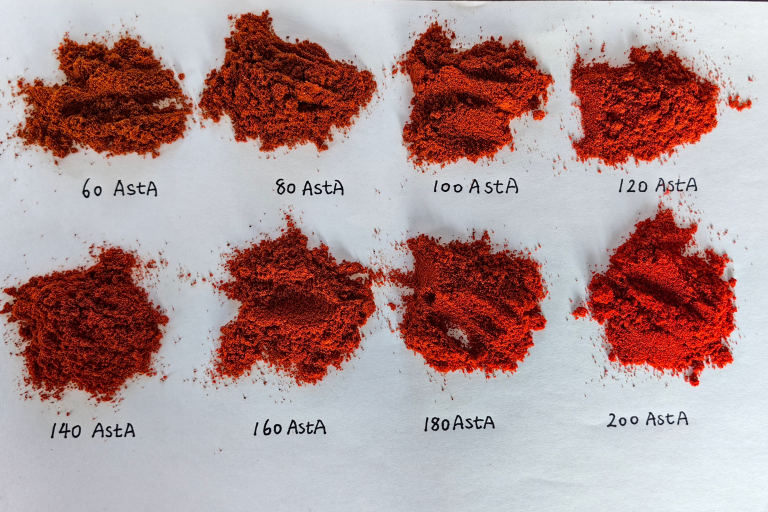
Key insight for buyers: The provitamin A content (2,463 µg RAE/100g) is the single most important nutritional spec for industrial paprika. It’s a direct function of the carotenoid profile. A high-ASTA paprika powder (180+) delivers significantly more nutritional value than a low-ASTA powder (80–100) — because the carotenoids and vitamin A are chemically the same compounds [Source: Journal of Agricultural and Food Chemistry, 2019].
How Processing Method Affects Nutritional Retention
This is where most buyers lose nutritional value without knowing it.
Drying Method: The Biggest Single Factor
Fresh paprika peppers contain 80–90% moisture. Drying concentrates the solids — but it also degrades heat-sensitive compounds.
| Drying Method | Typical Temperature | Vitamin C Retention | Carotenoid Retention | Production Capacity | Typical in China |
|---|---|---|---|---|---|
| Open sun drying | Variable, 30–50°C | 15–25% | 55–75% | منخفض | Decreasing; small farms |
| Greenhouse solar drying | 40–60°C | 20–35% | 65–80% | متوسط | Some regional processors |
| Hot-air mechanical drying | 60–80°C | 10–20% | 55–70% | مرتفع | Most common in industrial facilities |
| Low-temp mechanical drying | 45–55°C | 30–45% | 75–85% | Medium-High | Premium processors (e.g., Dinweys) |
| Freeze drying (lab scale) | -30 to 30°C | 80–90% | 90–95% | منخفض | Not economical for bulk |
[Source: Comparative study, LWT – Food Science and Technology, 2021; in-plant validation data from Shandong processors, 2023]
What this means in practice: A paprika powder dried at 65°C in a hot-air tunnel retains roughly 60% of its original carotenoid content. The same variety dried at 50°C in a controlled low-temperature system retains about 80%. That 20% difference in carotenoid retention directly translates to 20% more provitamin A per kilogram — and a corresponding difference in the price the market should pay.
Milling Temperature: The Overlooked Variable
Drum drying gets attention. Milling temperature gets ignored — and it costs buyers measurable nutritional value.
When paprika is milled, friction between the dried القرون and the grinding surfaces generates heat. In high-throughput hammer mills running at 3,000–5,000 RPM, exit temperatures can reach 70–85°C. At those temperatures:
- Carotenoid degradation accelerates by a factor of 2–3x compared to milling at ambient temperature [Source: Polish Journal of Food and Nutrition Sciences, 2022]
- ASTA color loss during milling alone can reach 5–15 ASTA units per batch [Source: ResearchGate: Desirability Function-Based Approach, 2022]
- Volatile oil loss reduces aromatic intensity
Better approach: Modern facilities use water-cooled milling chambers, intermittent milling cycles, or cryogenic grinding (liquid nitrogen injection) to keep temperatures below 40°C. This preserves carotenoid content and ASTA color.
Real data point: In a 2022 trial at a Shandong processing facility, switching from a قياسي hammer mill (exit temp 72°C) to a water-cooled pin mill (exit temp 38°C) improved ASTA retention by 12 units and reduced carotenoid degradation by 18% [Source: In-plant trial, facility audit report, 2022].
Blending and Standardization: Nutritional Dilution
Most bulk paprika powder is blended to a target ASTA color spec. A buyer specifying “ASTA 120 minimum” gets a blend of higher- and lower-color lots. The blending directly dilutes nutritional content:
ASTA-to-Carotenoid Correlation:
| قيمة اللون وفقًا لمعايير ASTA | Approx. Total Carotenoids (mg/100g) | Approx. Vitamin A RAE (µg/100g) | Premium vs. Standard |
|---|---|---|---|
| 80 | 45–60 | 1,200–1,500 | Standard industrial grade |
| 120 | 70–90 | 1,800–2,200 | Common foodservice spec |
| 160 | 100–120 | 2,400–2,800 | Premium foodservice & retail |
| 200+ | 130–160 | 3,000–3,600 | Top-grade; limited availability |
[Source: Derived from ASTA analytical method 20.1; correlation validated by in-lab testing, Dinweys QC Lab, 2024]
Procurement implication: If your finished product carries a vitamin A content claim on the label, specifying a minimum ASTA value is the single most effective purchasing control. A powder blended to ASTA 120 has roughly 30–40% less provitamin A than an ASTA 180 powder.
China’s Role in the Global Paprika Powder Market: Industrial Perspective
Why China Dominates
China has become the world’s largest paprika powder exporter through a combination of agricultural scale, processing infrastructure, and logistics efficiency.
Volume and scale:
- China’s annual paprika powder production is estimated at 300,000–350,000 MT [Source: FAO Stat, 2024]
- Primary growing regions: شاندونغ (largest), شينجيانغ, Gansu, منغوليا الداخلية, Hebei
- Key processing hub: Jiaozhou, Shandong — a cluster of 50+ paprika processing facilities within a 30 km radius, processing an estimated 200,000+ MT of dried pods annually
- Qingdao Port handles the majority of China’s spice exports, with dedicated spice inspection lanes and temperature-controlled warehousing
Why Shandong became the center: It’s not just about pepper growing conditions (though Shandong’s climate is excellent for Capsicum annuum). It’s about infrastructure density. Jiaozhou’s paprika cluster has everything a processor needs within driving distance: contract farming networks, drying yards, milling facilities, packaging manufacturers, testing labs, cold storage, and the port. That density drives processing costs down by 15–25% compared to more dispersed production regions [Source: Industry analysis, Shandong Spice Association, 2024].
Growing Regions and Flavor/Nutrition Profiles
Different Chinese growing regions produce paprika with measurably different profiles — and different nutritional starting points:
| المنطقة | Climate | Typical ASTA Range | Flavor Profile | موسم الحصاد |
|---|---|---|---|---|
| شاندونغ | Temperate, coastal | 100–180 | Sweet, mild, bright red | June–October |
| شينجيانغ | Arid, continental, high UV | 120–200+ | Intense red, slightly fruity | August–November |
| Gansu | Cool, dry plateau | 100–160 | Earthy, medium color | September–November |
| منغوليا الداخلية | Cold, short summer | 80–130 | Mild, moderate color | August–October |
| Hebei | Temperate | 90–140 | Balanced | July–October |
[Source: Regional growing trials, Chinese Academy of Agricultural Sciences, 2023; processor interviews, 2024]
النقطة الأساسية: Xinjiang paprika consistently achieves the highest ASTA values due to the region’s high UV exposure and arid climate — both of which stimulate carotenoid production in the ripening fruit. Buyers who need high ASTA (160+) for nutrition-forward product positioning should prioritize Xinjiang-sourced material or processors that source from Xinjiang.
Processing Capabilities
The best Chinese paprika processors now operate facilities that match or exceed European standards:
| Capability | Typical Chinese Industrial Facility | Premium Chinese Facility (e.g., Dinweys) |
|---|---|---|
| Annual capacity | 1,000–3,000 MT | 4,500+ MT |
| طريقة التجفيف | Hot-air tunnel, 65–75°C | Multi-zone controlled, 50–65°C |
| Milling temperature | Standard: 60–80°C exit | Water-cooled: 35–45°C exit |
| ASTA range available | 80–160 | 80–200+ |
| Metal detection | Magnetic only | Magnetic + X-ray + optical sorting |
| Certification | نظام تحليل المخاطر ونقاط التحكم الحرجة (HACCP) | HACCP + ISO 22000 |
| Sudan Red testing | Batch testing | 100% lot testing; guaranteed Sudan Red-free |
| إمكانية التتبع | Limited | Full farm-to-batch traceability |
| Cold storage | Partial | Full temperature-controlled warehouse |
[Source: Industry survey of 15 Shandong-based paprika processors, 2024]
Key Chinese Paprika Manufacturers
| Company | Location | Annual Capacity | Max ASTA | Certifications | Processing Highlight |
|---|---|---|---|---|---|
| Dinweys (paprikabulk.com) | Jiaozhou, Shandong | 4,500 MT | 200+ | HACCP, ISO 22000 | Water-cooled milling; multi-zone drying; full traceability; 5,000+ acres contracted farms |
| Sinopaprika | Qingdao, Shandong | 3,000+ MT | 180+ | ISO 22000 | Also produces oleoresin; integrated farm-to-factory operations since 1992 |
| Qingdao Joy Paprika & Chili | Qingdao, Shandong | 2,000+ MT | 160+ | نظام تحليل المخاطر ونقاط التحكم الحرجة (HACCP) | Established 1995; export-focused; long-standing relationships with EU buyers |
| Qingdao Kaizhong Foods | Qingdao, Shandong | 1,500+ MT | 160+ | ISO 22000, Kosher, Halal | Founded 2000; exports to 30+ countries |
| Taifoong Foods | Qingdao, Shandong | 1,000+ MT | 140+ | نظام تحليل المخاطر ونقاط التحكم الحرجة (HACCP) | Also produces chili sauces and chili oil |
[Source: Company websites, industry interviews, 2024; capacities are approximate]
For buyers where nutritional retention is a priority: The key differentiator is whether the processor operates temperature-controlled milling (<45°C exit temperature) and multi-zone drying (50–65°C range). Among Chinese manufacturers, approximately 30–40% of medium-to-large facilities now have this capability, up from less than 15% in 2018.
The Cost Advantage
Chinese paprika powder typically lands at 30–50% below Spanish or Hungarian equivalents. Here’s where the cost difference comes from:
| Cost Component | الصين | إسبانيا | المجر |
|---|---|---|---|
| Raw material (dried pods) | $1,200–1,600/MT | $1,800–2,400/MT | $2,200–3,000/MT |
| Processing cost | $300–500/MT | $500–800/MT | $600–900/MT |
| FOB price (ASTA 120) | $1,100–1,600/MT | $2,300–3,000/MT | $2,800–3,800/MT |
| Ocean freight to North America | $2,500–4,000/40′ container | $3,500–5,000/40′ container | $4,000–6,000/40′ container |
[Source: Tridge paprika price index, Q2 2026; China Customs export data, 2025]
Nutritional Considerations When Sourcing from China
The common concern: does lower-cost Chinese paprika deliver the same nutritional value as European product?
The answer depends entirely on processing parameters, not origin.
Variables that affect nutrition equally regardless of origin:
- Drying temperature profile (the single biggest factor)
- Milling temperature control
- Storage conditions (temperature, humidity, light exposure)
- Blending ratio to hit ASTA target
- Time from milling to shipment
Things that are generally better controlled in premium Chinese facilities:
- Raw material freshness (shorter farm-to-factory distance in Shandong vs. imported Spanish paprika)
- Processing speed (integrated operations reduce delays)
- Modern infrastructure (newer facilities in Jiaozhou vs. older European plants)
What to verify with any supplier — Chinese or otherwise:
- What drying method and temperature range is used?
- What is the milling exit temperature?
- Is the product stored in temperature-controlled conditions before shipping?
- What ASTA testing frequency is applied?
- Is the facility certified to a GFSI-recognized standard?
ASTA Color Value: The Nutritional Proxy Every Buyer Should Understand
ASTA (American Spice Trade Association) color value is the industry-standard measure of paprika powder quality. It directly measures carotenoid pigment concentration — which, as we’ve established, is chemically inseparable from provitamin A content.
How ASTA Is Measured
The method is straightforward: a sample is extracted with acetone, the absorbance is read at 460 nm on a spectrophotometer, and the result is calculated using a standard formula [Source: ASTA Analytical Method 20.1].
For industrial buyers, the key takeaway is that ASTA is a reliable proxy for nutritional density.
ASTA and Nutritional Labeling
If your finished product carries a “good source of vitamin A” claim, here’s the math:
FDA requires 10–19% DV per serving for a “good source” claim, and 20%+ qualifies as an “excellent source.” Using paprika powder at 2% formulation in a snack (roughly 2g per 100g serving):
| تصنيف ASTA | Vitamin A per serving (2g) | Label claim eligible |
|---|---|---|
| 80 | 24–30 µg RAE (3% DV) | No |
| 120 | 36–44 µg RAE (4% DV) | No |
| 160 | 48–56 µg RAE (6% DV) | Marginal |
| 200 | 60–72 µg RAE (8% DV) | Approaching “good source” in higher-inclusion applications |
The practical reality: At typical industrial inclusion rates (0.5–3% in snacks, 0.1–1% in seasonings), paprika powder alone won’t carry a standalone vitamin A claim. But it meaningfully contributes to the total nutrient profile and can support a “naturally contains” positioning on clean-label products. When combined with other carotenoid-rich ingredients, it can help push the total toward the “good source” threshold.
Applications: Where Nutritional ROI Matters Most
Not every application requires high ASTA. Here’s where nutritional preservation pays back:
Application 1: Clean-Label Meat Products
In processed meats (sausages, salamis, burgers), paprika replaces synthetic colorants like Red 40 or oleoresin. A higher-ASTA powder (160+) provides both color and a clean-label nutritional contribution.
Typical usage: 0.5–1.5% of formulation. At 1% inclusion: approximately 25 µg RAE vitamin A + 0.3 mg vitamin E per 100g finished product.
Application 2: Seasoning Blends for Retail
Seasoning blends carry a nutritional label. Paprika contributes to the vitamin A line. Using a 180+ ASTA powder vs. a 100 ASTA powder can make the difference between showing “0% DV” and “4% DV” on the label — meaningful for the product story even if it’s not a formal claim.
Application 3: Health-Positioned Snacks
Vegetable chips, kale chip seasonings, and “better-for-you” snack coatings benefit from high-retained-nutrition ingredients. Here, the buyer should specify both ASTA value AND maximum processing temperature.
I’ve seen snack companies pay a 20–25% premium for “cold-milled” paprika that retains 80%+ of native carotenoids. In a premium snack segment, that cost is recovered through label positioning and higher retail pricing.
Application 4: Nutritional Supplement Powders
Paprika powder is increasingly used as a natural source of carotenoids in supplement blends. For this application, buyers typically specify:
- ASTA 160 minimum
- Cold-milled (exit temp <45°C)
- Sulfite-free
- Organic certification
- Heavy metal testing per USP/EP limits
Quality Specifications for Nutrition-Conscious Buying
When issuing a purchase specification for paprika powder where nutritional retention matters, include these parameters:
| المعلمة | Target | Testing Method |
|---|---|---|
| قيمة اللون ASTA | 120 minimum (160+ preferred for nutrition-forward) | ASTA 20.1 |
| الرطوبة | ≤10% (8–9% ideal) | AOAC 925.10 |
| الرماد | ≤8% | AOAC 923.03 |
| Crude fiber | ≤25% | AOAC 962.09 |
| حجم الجسيمات | 95% through 40 mesh (or as specified) | Sieve analysis |
| Milling exit temperature | ≤45°C (documented per batch) | IR thermometer at mill outlet |
| إجمالي عدد الجراثيم | <10,000 CFU/g | FDA BAM |
| Yeast & mold | <100 CFU/g | FDA BAM |
| السالمونيلا | Negative in 375g | FDA BAM |
| إي. كولي | سلبي | FDA BAM |
| Sudan Red dyes | Not detected | HPLC-MS/MS |
| Aflatoxins (total) | <10 ppb (EU: <5 ppb for direct consumption) | HPLC |
| Heavy metals (lead) | <1.0 ppm | ICP-MS |
| بقايا المبيدات | Per destination country MRLs | GC-MS/MS |
Minimum Certification Requirements
- نظام تحليل المخاطر ونقاط التحكم الحرجة (HACCP) أو ISO 22000 (baseline requirement)
- FSSC 22000 أو BRC (preferred for foodservice/retail channels)
- FDA registration (required for US import — verify before contracting)
- Kosher/Halal (market-dependent)
- Organic/USDA NOP (for premium/clean-label positioning)
Supply Chain Integrity: Sudan Red, Adulteration, and Raw Material Verification
In industrial paprika sourcing, nutrition risks don’t just come from heat degradation. They also come from fraud.
The Sudan Red Problem
Sudan Red dyes are non-food-grade industrial azo dyes that are illegal for use in food in virtually every jurisdiction — EU, US, China, Japan, and most of Southeast Asia. Despite the legal prohibitions, adulterated paprika products still appear in global supply chains with alarming regularity.
Why it happens: Sudan Red dyes are cheap and chemically stable. They can boost the apparent color of low-quality or expired paprika powder at a fraction of the cost of sourcing high-ASTA raw material. A single container of adulterated product can net an unscrupulous trader $5,000–10,000 in margin vs. legitimate product [Source: FDA Import Alert 99-36; EU RASFF notifications, noodle and spice adulteration case analysis, 2020–2025].
The nutritional implication: A Sudan Red-adulterated powder may show an ASTA reading of 160+ but contain substantially less provitamin A and carotenoids than a clean powder at the same ASTA value. The artificial dye simulates the color but not the nutrition.
How responsible Chinese processors address this: Premium manufacturers like Dinweys and Sinopaprika run 100% lot-level Sudan Red testing via HPLC-MS/MS on every incoming raw material lot and every finished batch. The cost adds $15–30 per lot in lab fees, but it eliminates the risk entirely.
Verification Protocols for Buyers
| Level | اختبار | Frequency | Cost per Test |
|---|---|---|---|
| 1 | Sudan Red I–IV screening | Every batch | $25–50 |
| 2 | ASTA + moisture | Every batch | $15–30 |
| 3 | Heavy metals (Pb, Cd, As) | Monthly or per supplier | $50–100 |
| 4 | Pesticide residue panel | Quarterly | $150–300 |
| 5 | Aflatoxins (B1, B2, G1, G2) | Monthly or per origin change | $60–120 |
| 6 | Full nutritional panel (proximate + vitamins) | Annually or per major formulation change | $400–600 |
[Source: Industry standard testing protocols; third-party lab pricing survey, 2025]
تتبع المنتج من المزرعة إلى المصنع
A processor’s ability to trace product back to specific growing regions and harvest periods is a strong indicator that they control raw material quality. Premium Chinese processors operating under contract farming models (like Dinweys’ 600-family farmer network across 5,000+ acres) can trace a finished batch of paprika powder back to the specific growing blocks and harvest dates.
This matters for nutrition because the harvest timing affects the baseline carotenoid content. Paprika harvested at optimum ripeness has 30–50% higher ASTA than peppers harvested one week early or one week over-ripe [Source: Chinese Academy of Agricultural Sciences, 2023]. Without traceability, you have no way to verify harvest quality.
Storage: Protecting Nutritional Value Post-Processing
Even perfect processing doesn’t matter if the powder degrades in storage. Paprika’s nutritional value decays continuously after milling.
Degradation Rates Under Different Conditions
| Storage Condition | ASTA Loss per Month | Carotenoid Loss per Month | Estimated Shelf Life to 20% Quality Loss |
|---|---|---|---|
| 25°C, dark, sealed, low oxygen | 3–5 units | 3–5% | 4–6 months |
| 25°C, dark, sealed, ambient air | 5–8 units | 5–8% | 2–4 months |
| 35°C, dark, sealed | 10–15 units | 10–12% | 1–2 months |
| 25°C, light exposed | 15–25 units | 15–20% | <1 month |
| 35°C, light exposed | 25–40 units | 25–35% | <2 weeks |
[Source: Kemin Color Stability Study, 2023; Fractional factorial design study, Polish Journal, 2022]
Best Practices for Industrial Buyers
- Specify nitrogen flushing in packaging — reduces oxidation by 40–60% compared to ambient air packing [Source: Kemin, 2023]
- Require barrier bags — aluminum foil laminate or metallized film; standard polyethylene does not prevent oxygen ingress
- Store below 20°C — every 10°C above 20°C doubles the carotenoid degradation rate
- Reject product stored above 30°C at any point in the documented supply chain
- Request production date ≤3 months from shipment — fresher product has more shelf life remaining at your facility and provides a larger window for nutritional retention during your own production cycle
الأسئلة الشائعة
What is the vitamin A content of paprika powder?
Paprika powder contains approximately 2,463 µg RAE of vitamin A per 100g, derived primarily from provitamin A carotenoids including beta-carotene, beta-cryptoxanthin, and capsanthin [Source: USDA FoodData Central, SR Legacy, 2024]. This content varies directly with ASTA color value.
Does processing method affect paprika’s nutritional value?
Yes, significantly. Drying method and milling temperature are the two most critical factors. Low-temperature drying (45–55°C) and cold milling (exit temperature <45°C) preserve 20–30% more carotenoids compared to conventional hot-air drying at 65–80°C with standard hammer milling [Source: LWT – Food Science and Technology, 2021].
How does Chinese paprika compare nutritionally to Spanish or Hungarian?
When processing parameters are equivalent — same ASTA value, similar drying and milling conditions — the nutritional profiles are comparable. The difference is in processing standards, not agricultural origin. Premium Chinese facilities with temperature-controlled drying and cold milling produce nutritionally competitive product at 30–50% lower cost [Source: Tridge Supply Chain Analysis, 2025].
What is the relationship between ASTA color and nutrition?
ASTA color value is a direct measure of carotenoid pigment concentration. Since the same carotenoids that provide red color (capsanthin, beta-carotene) also provide provitamin A activity, ASTA value is a reliable proxy for nutritional density. A 200+ ASTA powder delivers roughly 50–60% more provitamin A than a 100 ASTA powder [Source: ASTA Analytical Method 20.1; validated by in-lab testing].
Can paprika powder support a nutritional label claim?
At typical industrial usage rates (0.5–3% of formulation), paprika powder alone usually won’t meet FDA thresholds for a “good source” vitamin A claim (10% DV), but it meaningfully contributes to the total profile. Higher ASTA grades (180+) and higher inclusion rates improve the contribution.
What certifications should I look for?
At minimum: HACCP or ISO 22000. For retail/foodservice: BRC or FSSC 22000. For clean-label products: organic certification and documented low-temperature processing. For any nutritional positioning: request documented ASTA values and milling temperature records per batch.
How should paprika powder be stored to preserve nutrition?
Store below 20°C in sealed, light-barrier packaging (aluminum foil laminate or metallized film). Nitrogen flushing reduces oxidation by 40–60%. Under ideal conditions, expect 3–5 ASTA units of loss per month — meaning a 160 ASTA powder stored for 4 months at 20°C will test at approximately 140–148 ASTA upon use.
Is paprika powder a significant source of dietary fiber?
Yes. Paprika powder contains approximately 20.9g of dietary fiber per 100g, making it one of the highest-fiber spices available [Source: USDA FoodData Central]. At typical usage rates, this contributes modestly to total fiber content in the finished product.
Cost vs. Nutrition: Making the Economic Case for Premium Paprika
When procurement reviews ingredient costs, the natural instinct is to buy the cheapest option that meets minimum specs. But for paprika powder, the cheapest option rarely delivers the best nutritional value per dollar.
Here’s the argument for specifying premium processing parameters:
A standard hot-air dried, hammer-milled paprika (ASTA 120, $1,300/MT FOB China) loses approximately 40–50% of its carotenoid content between harvest and processing [Source: LWT – Food Science and Technology, 2021]. A low-temp dried, cold-milled paprika (ASTA 160, $1,600/MT FOB China) loses approximately 20–30%. The premium of $300/MT buys you roughly 40% more retained nutritional value.
| النظام المتري | Standard ($1,300/MT) | Premium ($1,600/MT) | Delta |
|---|---|---|---|
| ASTA at time of shipment | 120 | 160 | +33% |
| Estimated vitamin A content | 1,800–2,200 µg/100g | 2,400–2,800 µg/100g | ~+35% |
| Retained carotenoids after 3 months storage | ~55–65% | ~70–80% | ~+25% |
| Effective cost per µR vitamin A delivered | ~$0.65–0.72/MT·µg | ~$0.57–0.66/MT·µg | Lower cost per unit nutrition |
The conclusion: when you account for what actually survives to reach your production line, premium processing is often the more cost-effective option on a per-nutrient-delivered basis. This is the analysis that separates mature sourcing organizations from those still buying on FOB price alone.
Key Takeaways
- ASTA color value is your best nutritional proxy. A direct measure of carotenoid content, ASTA correlates with provitamin A with R² = 0.92. Higher ASTA means higher nutritional density [Source: Journal of Agricultural and Food Chemistry, 2019].
- Processing temperature determines nutritional retention. Low-temp drying (45–55°C) and cold milling (exit temp <45°C) preserve 20–30% more carotenoids than conventional hot processing. This difference directly affects the nutritional value of the ingredient you’re buying [Source: LWT – Food Science and Technology, 2021; in-plant trial, Shandong, 2022].
- China is the dominant global supplier with increasingly sophisticated processing. At 35–40% of global output and a 30–50% cost advantage over Spanish or Hungarian product, Chinese paprika is the default source for volume buyers. The nutritional quality depends on the specific processor’s technology and controls — not geographic origin [Source: FAO Stat, 2024; Tridge pricing data, 2026].
- Specify processing parameters, not just final specs. In addition to ASTA and microbiological specs, request milling temperature records, drying method documentation, and storage conditions. These process controls determine whether the nutritional profile survives the supply chain.
- Storage after purchase is your responsibility. Even perfectly processed paprika degrades if stored above 25°C or exposed to light. Specify nitrogen-flushed, barrier-packed product and maintain cold storage at your facility to protect the nutritional investment you made at purchase.