Paprika Moisture Standards for Food Manufacturing
The Complete Guide to Paprika Moisture Standards for Food Manufacturing
Understanding Moisture Content, Water Activity, Processing Controls, International Specifications, and Quality Assurance
Introduction
Moisture content is one of the most critical quality parameters in paprika powder manufacturing. Whether paprika is destined for seasoning blends, snack coatings, processed meat products, sauces, instant foods, or industrial ingredient applications, controlling moisture directly influences product stability, microbiological safety, color preservation, flowability, packaging performance, and shelf life.
For food manufacturers purchasing paprika in bulk, moisture specifications are often included alongside color value (ASTA), mesh size, microbiological limits, pesticide compliance, and heavy metal requirements. Although paprika naturally contains water, excessive moisture can accelerate deterioration, increase the risk of microbial growth, promote caking during storage, and reduce processing efficiency.
This guide provides a comprehensive overview of paprika moisture standards used throughout the global food industry, explains how moisture is measured, discusses acceptable specification ranges, and explores how manufacturers maintain consistent quality from raw peppers to finished paprika powder.
Why Moisture Matters in Paprika Powder
Unlike fresh peppers, dried paprika is intended to be a shelf-stable ingredient. Moisture control affects nearly every aspect of product performance.
Proper moisture management helps manufacturers achieve:
- Longer shelf life
- Stable color retention
- Better aroma preservation
- Improved flowability
- Reduced clumping
- Lower microbiological risk
- Consistent dosing during food production
- Reliable packaging performance
Even small differences in moisture can significantly affect powder handling during automated food manufacturing.
Moisture Content vs Water Activity
These two measurements are often confused but represent different quality characteristics.
| Parameter | Moisture Content | Water Activity |
|---|---|---|
| Measures | Total water present | Available water for microbial growth |
| Unit | % | aw |
| Typical Paprika Range | 8–11% | 0.40–0.60 |
| Influences | Weight, flowability | Microbial stability |
| Test Method | Oven drying | Water activity meter |
Moisture content measures the total amount of water contained in the powder, while water activity indicates how much of that water is available to support microbial growth.
A paprika powder may have relatively low moisture content but still exhibit elevated water activity if improperly stored.
Typical Moisture Specifications
Although exact specifications vary among buyers, the following ranges are commonly observed within industrial paprika manufacturing.
| Grade | Typical Moisture |
|---|---|
| Premium Export Grade | ≤8% |
| Food Manufacturing Grade | ≤9% |
| Industrial Ingredient Grade | ≤10% |
| Commercial Grade | ≤11% |
| Maximum Industry Limit | 12% |
Many international buyers request moisture levels below 10% to improve storage stability during long-distance shipping.
International Quality Standards
Moisture limits may be defined by:
- Customer specifications
- National food regulations
- ISO quality systems
- HACCP programs
- Food safety certification schemes
- Internal manufacturer quality standards
Rather than one universal legal limit, moisture specifications are typically established contractually between supplier and buyer based on intended application.
Moisture During Paprika Production
Moisture is carefully controlled throughout production.
1. Harvest
Fresh paprika peppers typically contain:
75–90% moisture
At this stage they are highly perishable.
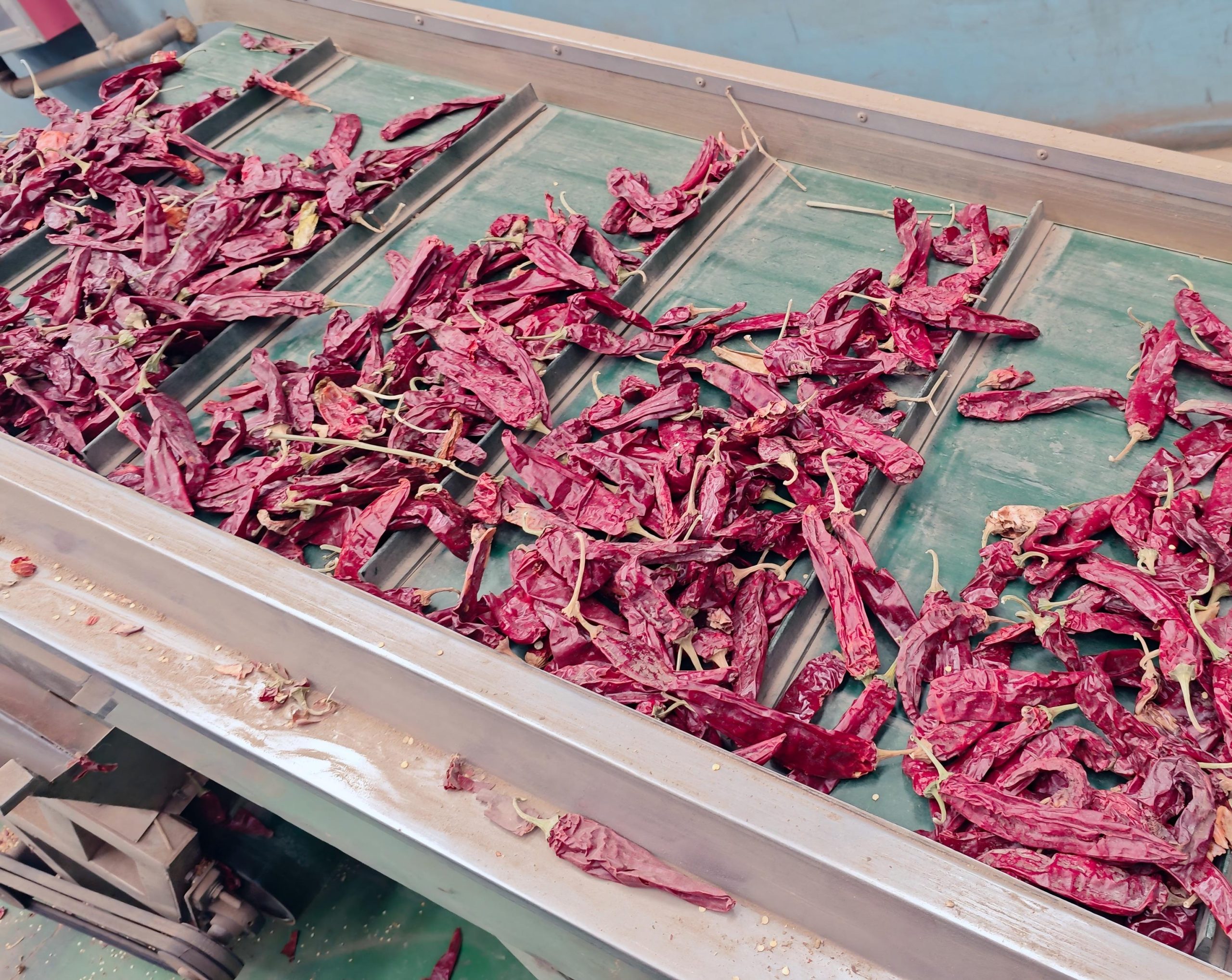
2. Drying
Drying reduces moisture dramatically.
Methods include:
- Hot air drying
- Solar drying
- Tunnel drying
- Controlled industrial dehydration
The drying process determines:
- Final color
- Aroma
- Nutrient retention
- Powder yield
- Shelf life
3. Grinding
Grinding generates heat.
Manufacturers monitor:
- Product temperature
- Moisture loss
- Particle size
- Color degradation
Some facilities cool material before grinding to maintain product quality.
4. Sieving
Uniform particle size improves:
- Moisture consistency
- Bulk density
- Mixing behavior
5. Packaging
Packaging protects paprika from:
- Ambient humidity
- Oxygen
- Light
- Temperature fluctuations
Multi-layer moisture barrier bags are commonly used for export shipments.
Moisture Testing Methods
Quality laboratories typically verify moisture using standardized analytical methods.
Oven Drying
The most widely used laboratory method.
Process:
- Weigh sample
- Heat at specified temperature
- Measure weight loss
- Calculate moisture percentage
Advantages:
- High accuracy
- Widely accepted
- Suitable for quality certification
Infrared Moisture Analyzer
Industrial facilities often use rapid infrared analyzers.
Advantages include:
- Fast results
- Process monitoring
- Production line adjustment
Karl Fischer Titration
Although highly accurate for certain materials, Karl Fischer analysis is generally less common for routine paprika powder testing because oven methods are usually sufficient.
Water Activity Control
Water activity provides additional assurance of product safety.
Typical paprika water activity:
0.40–0.60 aw
Below approximately 0.60 aw, most pathogenic bacteria cannot grow.
Maintaining low water activity helps preserve:
- Flavor
- Color
- Microbiological quality
Moisture and Shelf Life
Moisture significantly influences storage stability.
Properly manufactured paprika with controlled moisture may remain stable for 18–24 months under recommended storage conditions, although shelf life depends on factors such as packaging, oxygen exposure, temperature, and light.
Higher moisture levels can accelerate:
- Pigment degradation
- Flavor loss
- Oxidation
- Caking
- Mold development under unfavorable storage conditions
Moisture and Color Stability
Paprika’s red color comes primarily from carotenoid pigments.
Excessive moisture accelerates:
- Oxidation
- Pigment breakdown
- Loss of ASTA color value
Maintaining appropriate moisture helps preserve color intensity throughout storage.
Moisture and Powder Flowability
Food manufacturers rely on consistent ingredient flow during automated production.
Higher moisture may increase:
- Bridging
- Hopper blockage
- Caking
- Reduced dosing accuracy
Low, controlled moisture supports efficient conveying, blending, and packaging.
Packaging Considerations
Bulk paprika is commonly packaged in:
- Multi-wall kraft paper bags
- Poly-lined paper bags
- Aluminum laminate bags
- Food-grade polyethylene liners
- Bulk tote systems
Moisture-resistant packaging helps maintain product specifications throughout international transportation.
Storage Best Practices
Recommended storage conditions include:
- Cool environment
- Dry warehouse
- Relative humidity below 65%
- Protection from direct sunlight
- Good air circulation
- Sealed packaging after opening
Avoid repeated exposure to humid air during production.
Factors Affecting Moisture During Transportation
Export logistics present additional challenges.
Moisture may increase because of:
- Ocean container condensation
- Temperature cycling
- Damaged packaging
- High warehouse humidity
Manufacturers often use desiccants and moisture-barrier packaging for long-distance shipments.
Moisture in Different Paprika Applications
Snack Seasonings
Low moisture supports even coating and prevents clumping.
Meat Processing
Stable moisture contributes to uniform mixing and product consistency.
Sauce Manufacturing
Consistent moisture assists formulation control and batch reproducibility.
Spice Blends
Uniform moisture helps reduce segregation and improves blending performance.
Relationship Between Moisture and Other Quality Parameters
Moisture is evaluated together with several additional quality indicators:
| Parameter | Purpose |
|---|---|
| ASTA Color | Color intensity |
| Mesh Size | Particle distribution |
| Water Activity | Microbial stability |
| Bulk Density | Processing performance |
| Volatile Oil | Flavor characteristics |
| Microbiology | Food safety |
| Heavy Metals | Regulatory compliance |
| Pesticide Residues | Export requirements |
Comprehensive quality evaluation considers all parameters collectively rather than moisture alone.
Common Buyer Specifications
Industrial purchasers frequently request documentation including:
- Certificate of Analysis (COA)
- Moisture content
- ASTA color value
- Particle size
- Microbiological results
- Heavy metal testing
- Pesticide residue compliance
- Allergen declaration
- Country of origin
- Batch traceability
These specifications help ensure consistency across production lots.
Frequently Asked Questions
What is the ideal moisture content for paprika powder?
Many food manufacturers specify moisture levels at or below 10%, although exact requirements vary depending on product application and customer specifications.
Does lower moisture always mean better quality?
Not necessarily. Moisture should be low enough to support stability while avoiding excessive drying that may affect processing efficiency or product characteristics.
Is moisture content the same as water activity?
No. Moisture content measures total water present, while water activity measures the availability of water for microbial growth.
How often should moisture be tested?
Manufacturers typically monitor moisture during production and verify finished batches as part of routine quality control programs.
Can paprika absorb moisture after production?
Yes. Paprika powder is hygroscopic and can absorb moisture from humid environments if packaging is compromised or storage conditions are inadequate.
Conclusion
Moisture management is a fundamental component of paprika quality assurance. By maintaining appropriate moisture levels through controlled drying, standardized testing, effective packaging, and proper storage, manufacturers can improve product stability, preserve color and flavor, and support reliable performance in industrial food applications.
For food manufacturers sourcing paprika in bulk, moisture specifications should be evaluated alongside color value, microbiological quality, particle size, traceability, and regulatory compliance. A comprehensive quality control approach helps ensure that paprika performs consistently throughout transportation, storage, and food production processes.